A UK fragrance retailer selling oriental and designer-inspired perfumes at 40–60% below luxury brand prices needed fast answers to three strategic questions: which social platforms would actually convert, which sales channels to prioritise for margin and volume, and whether to position the brand as a transparent dupe or build an independent oriental luxury identity.
The decision
The client needed clarity before committing marketing budget. TikTok was generating views but no sales. Amazon was their primary channel but eroding margins. Every decision about channel mix and brand positioning carried real financial risk.
The simulation
Simplutech used MiroFish-powered multi-agent simulation with the client’s full business brief as seed material. Three scenarios were run — each targeting one strategic question — with 100 autonomous agents over 40 rounds per scenario. The model tested UK customer behaviour across social platforms, ordering channels, and brand perception.
The three scenarios
Each scenario addressed one question and produced a full structured report.
Scenario 01 — Social Media & Content Strategy
Question: Which social media platform will generate the strongest sales conversion in the UK market? What content format works best for a value-premium fragrance brand? How do we turn TikTok viewers into buyers?
Finding: Instagram is the primary conversion platform. TikTok Shop must be activated immediately. Micro-influencers and short-form video drive the strongest conversion.
Download report (PDF) →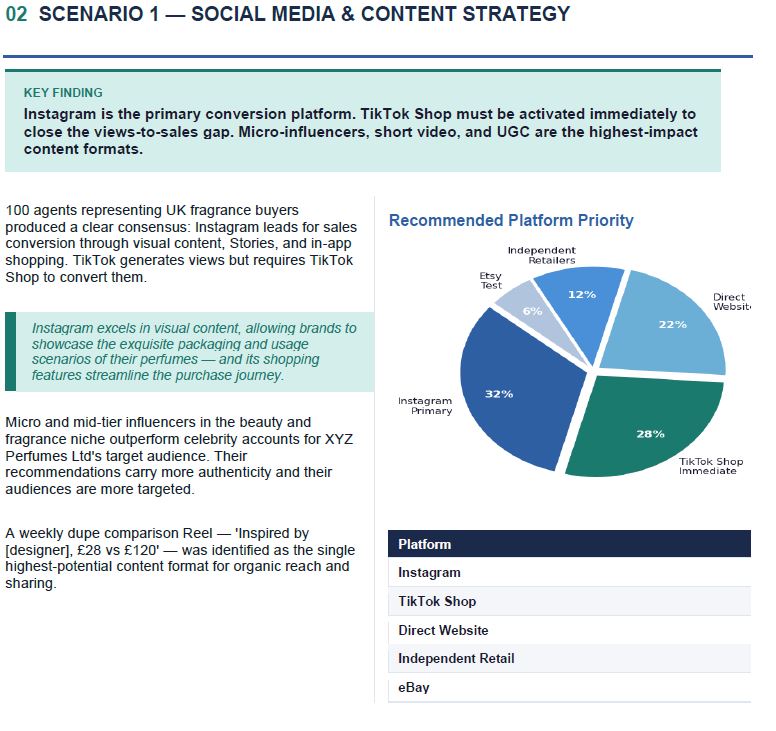
Scenario 02 — Sales Channel Strategy
Question: Should we prioritise Amazon, invest in direct website traffic, or explore new channels like TikTok Shop, Etsy, or independent retailers? Which channel delivers the best volume and margin over 6 months?
Finding: Diversify away from Amazon. TikTok Shop is the single most important new channel. Independent retailers are an underexplored high-value route to new audiences.
Download report (PDF) →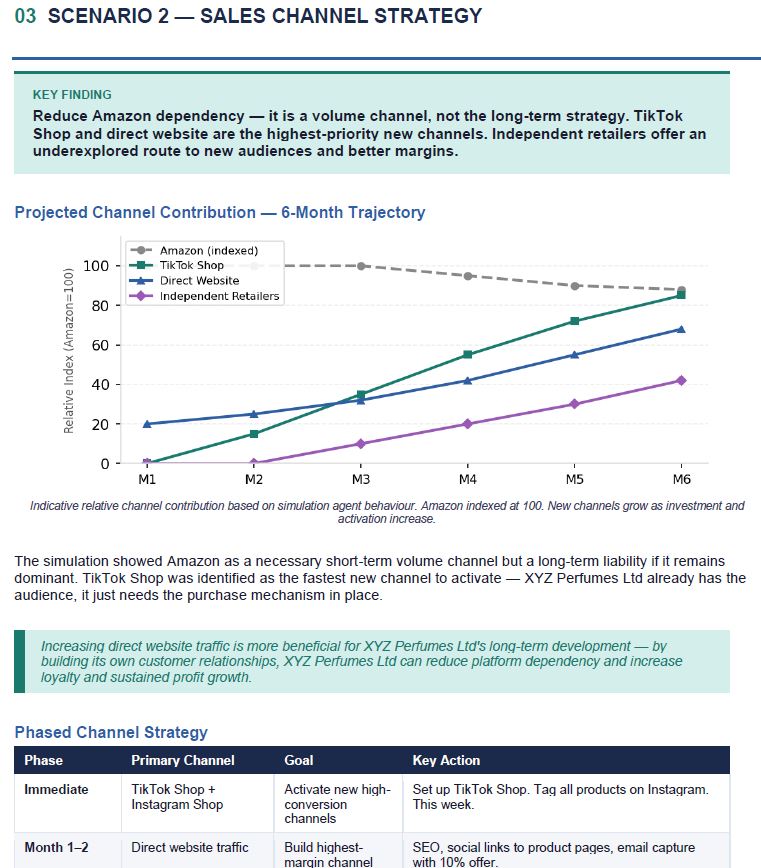
Scenario 03 — Brand Positioning
Question: Should we market openly as a designer dupe brand, or build an independent oriental luxury identity? Which positioning generates stronger loyalty and long-term brand equity?
Finding: Neither is wrong — timing is everything. Use dupe-adjacent content to build the audience, then migrate toward the independent oriental identity from month 3 onwards.
Download report (PDF) →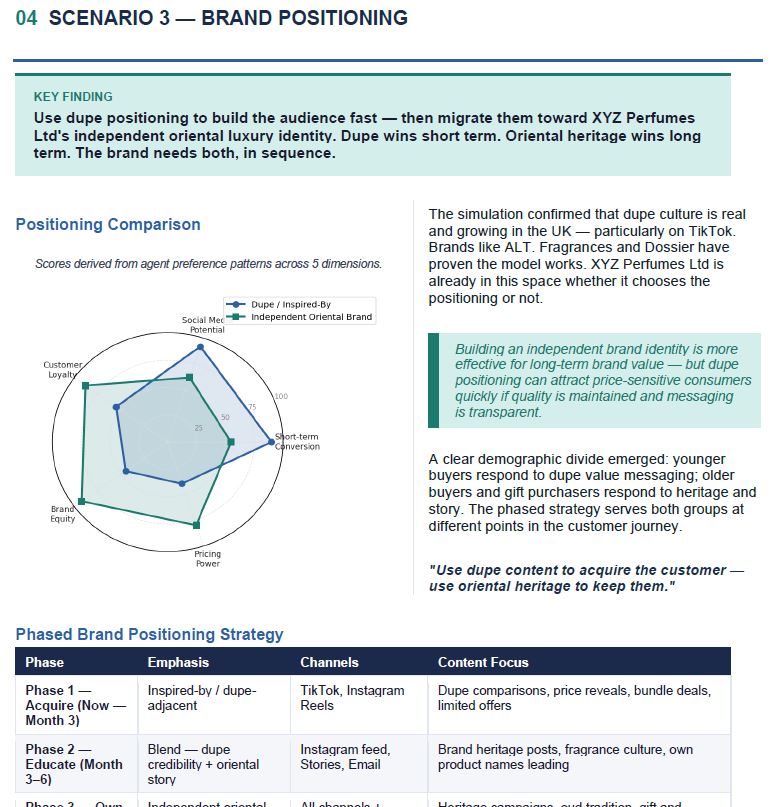
The executive summary
All three scenarios were synthesised into a combined executive strategy report covering integrated recommendations, a 6-month channel trajectory, combined risk matrix, and a 12-action priority plan.
Contents: agent sentiment across all three scenarios, platform priority distribution, brand positioning radar, 6-month channel contribution forecast, combined risk matrix, 13-point integrated growth strategy, and 12-action priority plan with owners and timelines.
Download executive summary (PDF) →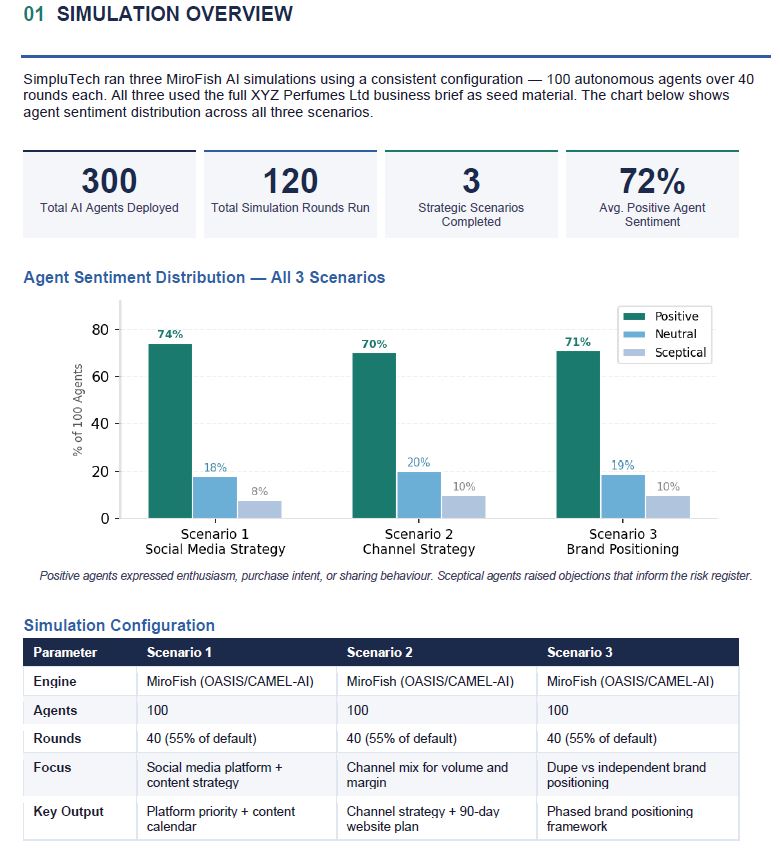
Why simulation was used
Traditional market research could not test the interaction between social media behaviour, channel economics, and brand perception simultaneously — and could not predict how real customers would respond to the specific combination of pricing, product, and positioning that XYZ Perfumes Ltd was bringing to market.
OutcomeLab simulated customer responses across all three dimensions before any budget was committed — surfacing findings the founders had not anticipated, including that TikTok views would never convert without TikTok Shop, that Amazon should be treated as a customer acquisition channel rather than the primary business, and that dupe positioning and independent brand identity are a sequence rather than a choice.
The outcome
The simulation recommended activating TikTok Shop immediately to convert existing views into sales, treating Amazon as an acquisition channel rather than the primary business, approaching independent gift retailers as an underexplored distribution route, and using a phased brand strategy — dupe content first to build the audience, then oriental heritage content to build loyalty.
The value
The output was a growth roadmap covering social media strategy, channel prioritisation, brand positioning, risk mitigation, and a 12-action priority plan. Three strategic questions turned into a structured 6-month plan — before committing a single pound of marketing budget.
Disclaimer: OutcomeLab reports are decision-support tools, not guarantees. Results depend on available data, stated assumptions and real-world execution.